
How Do Managed Security Services Monitor Network Traffic?
Managed Security Services Monitor Network Traffic
The business of managed security services is a specialized offering where businesses entrust their cybersecurity infrastructure and services to external experts, known as managed security service provider (MSSPs). These entities monitor the digital perimeter 24/7/365 and employ a variety of tools and techniques to detect, address and mitigate potential cyber threats. This allows organizations to focus on growth and innovation and lets them rest easy knowing that their systems are protected.
In order to protect networks, MSSPs use a variety of monitoring software, including network security monitoring, intrusion detection and response, and vulnerability scanning. They also provide a variety of other services to their clients, including cybersecurity training and forensics. Some even have their own security operations centers, from which they oversee client networks and monitor for threats.
Network Security Monitoring (NSM) is the day-to-day monitoring of activity in a business’s network and the analysis of that data. It identifies anomalies, malicious behavior, and potential threats in real-time or near-real time. This allows for a quick reaction, which can significantly reduce the risk of a breach and protect sensitive information.
Vulnerability Scanning: An MSSP can scan the network for areas where bad actors might find entry points, such as unpatched programs or outdated hardware. They can also look for less obvious vulnerabilities, such as the use of passwords that are too simple or common. Then, they can use these results to improve the firewall’s ability to detect and block attacks.
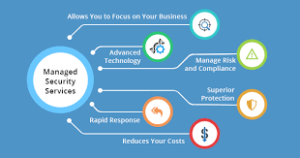
How Do Managed Security Services Monitor Network Traffic?
Firewall Services: An MSSP will deploy and manage firewall solutions for their clients, depending on the size of the network. This includes granting permissions to employees based on their roles and responsibilities, onboarding new hires in the tech system, recording, and providing log data, and troubleshooting when there is an incident. It can also work closely with the database manager to help ensure that data is protected and secure.
Identity and Access managed security service provider: An MSP will offer IAM solutions that align with compliance regulations, industry standards and business processes. This includes user provisioning, authentication, access control and privileged access management (PAM) to enforce least privilege access and strengthen the security posture.
An excellent MSSP will act as a true partner, working with businesses to ensure they have the necessary resources to implement and sustain the necessary security protocols. They will also provide training for employees on how to recognize and react to suspicious activities, improving overall security.
An MSP will also provide cybersecurity training to their clients’ staff. This is to help educate employees about the company’s security protocols and how to avoid cyberattacks. This can be especially helpful when an organization lacks the resources to develop and deliver its own internal training. An MSP can fill in the gaps left by a depleted cybersecurity team or replace it altogether. This can be particularly useful for small and mid-sized businesses that do not have the budget to hire full-time cybersecurity professionals. As such, they can save money while gaining the peace of mind that comes with having an experienced, professional MSSP in place to manage their critical assets.